
3 min read
Morningstar’s Voice of the Advisor Study: How Can Today’s Financial Advisors Deliver Value?
Four practical tips for deepening client relationships featuring our latest industry insights.

Key Takeaways
- Evolving client demands reflect a more engaged investor—particularly in the area of service expectations, like real time communication.
- The growing interest in private markets continues with most financial advisors anticipating their clients’ allocation will increase over the next year.
- Financial advisors are primarily using generative AI to improve internal productivity.
How can advisors stand out in a rapidly changing industry?
They need to deliver results beyond returns—they must build personalized strategies that align with investor goals while providing financial education, emotional support, and more.
Morningstar’s 2025 Voice of the Advisor study offers actionable insights on the wide-ranging attitudes, behaviors, and preferences of financial advisors. You can use these insights to understand how to differentiate your practice, stand out from the competition, and strengthen client trust.
Our findings are based on 527 total online responses with participants represented across gender, generation, firm type, career tenure, size of practice, and assets under management (AUM).
By knowing how to gain an edge, advisors can prove their true value and move forward with confidence. Here are four actionable tips to consider.
To read the full research report, download a copy.
Navigate Market Turmoil by Prioritizing Investor Goals
Despite a transforming landscape, 44% of financial advisors reported feeling generally optimistic about the current market. Their primary concerns shifted from tariffs and trade policy (41%) and geopolitical tensions (37%) in the summer to economic slowdown and recession (45%) and market volatility (32%) in the fall. This shows that advisors may feel more unease around timely trends compared to evergreen ones.

Advisors feel more concern around timely trends compared to evergreen ones.
By cutting through the noise and focusing on the fundamentals of investing along with goal attainment, financial advisors can be a source of calm for clients while delivering long-term solutions.
Advisors can also use our risk tolerance questionnaire to help investors understand their comfort with investment risk and opt for more informed trade-offs—which can then support advisors in building better plans that account for a client’s preferences.
Focus on Investors’ Non-Financial Needs
While delivering financial value is still considered a success factor, it may no longer be enough for clients. Financial advisors reported that service expectations—as in real-time communications, personalized recommendations, and more involvement in the decision-making process—is the area that has changed the most in the past two years (22%).
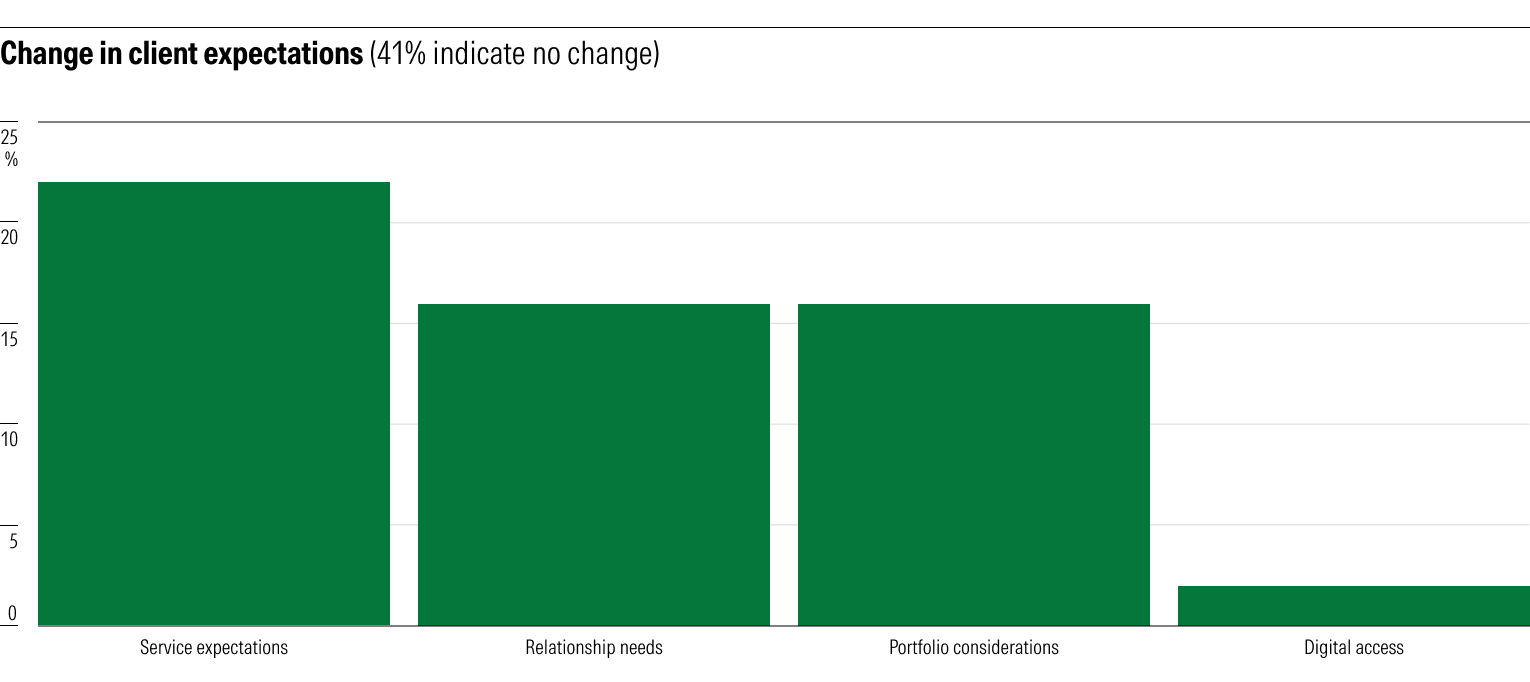
Service expectations is the client demand area that has changed the most in the past two years.
In other words, investors wish to be active participants in their investment journey and want both tailored solutions and results beyond returns. To meet the needs of more engaged investors, advisors must spend an adequate amount of time identifying clients’ goals with in-depth questions, providing context around recommendations, and communicating frequently.
Address Private Market Due Diligence Challenges
The rise of private markets is impossible to ignore—global private fund assets under management have nearly tripled since 2015.
This shift isn’t just a trend but an increasing opportunity: Our study reveals that half of financial advisors (50%) who are already offering private investments anticipate that their clients’ allocation will increase over the next year.
Still, advisors have concerns about private investments’ high fees (38%), limited liquidity (36%), and lack of transparency into underlying holdings (34%) as key due diligence hurdles.
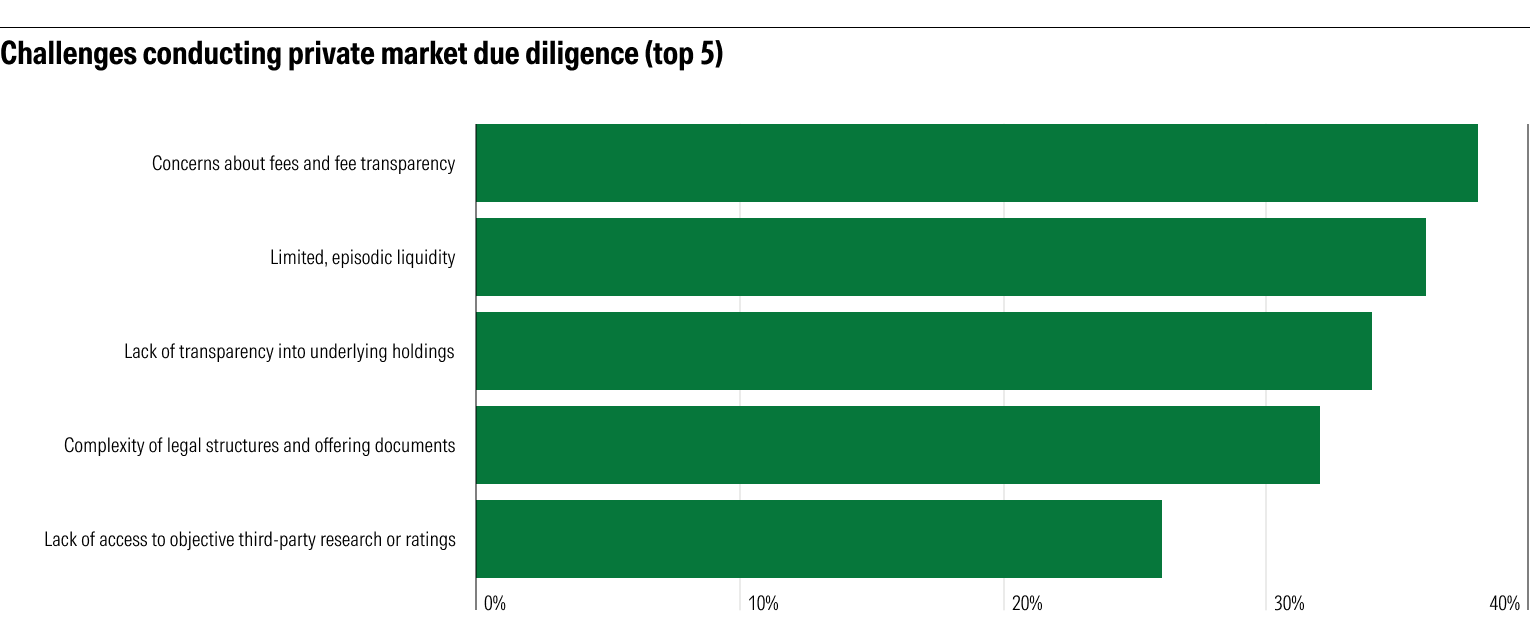
Concerns about fees and fee transparency are the top challenge for advisors in private markets.
To capitalize on this growing market, financial advisors must go beyond the basics—deepening their understanding of fee structures, developing innovative portfolio strategies, and proactively addressing client concerns.
Use Generative AI to Manage Tasks
Generative AI is reshaping the way financial advisors work, with its influence expected to grow significantly. Currently, about two-thirds of financial advisors (67%) are using generative AI in their practice—primarily for internal productivity like meeting summaries (26%), idea generation or brainstorming (25%), and client communications (25%).

The top way asset managers use AI is for research.
Notably, almost two-thirds (63%) reported its biggest impact could be improving efficiency in client communications such as summarizing notes and drafting emails.
By leveraging AI to streamline workflows, advisors can free up time to focus on what matters most—building deeper, trust-based relationships with clients. Tools like Morningstar’s Mo can help advisors strike this balance to ensure that technology enhances, rather than replaces, the human element of financial advice.
Ready to Better Support Clients?
Advisors who help clients navigate complexity, behavior, and long-term planning will be more likely to outperform peers who rely solely on recommendations.
For more insights on navigating the changing industry and meeting evolving client expectations, check out our webinar with Morningstar’s Joseph Agostinelli, Senior Director of Market Research, and Thomas Aviles, Head of Advisor Software, Direct Platform.