
6 min read
Active ETF Launches and Closures: 2025 in Review

Key Takeaways
Nearly 1,000 active ETFs launched last year, compared with only 95 mutual funds, 150 passive ETFs, and the previous record of 584 in 2024.
The 146 active ETFs that closed in 2025 were less than half the 357 traditional mutual funds that met their demise, but it was still an active ETF record. Meanwhile, just 86 passive ETFs shuttered.
If you are looking for an active ETF with a good chance of being around for a while, picking one with more assets would be a good bet.
Active ETFs took in roughly $475 billion in inflows, or about one-third of the new money for all ETFs in 2025. Close to 1,000 active ETFs launched, accounting for 35% of the roughly 2,800 US-domiciled active ETFs. The previous high was 584 in 2024. There were only 150 passive ETF and 95 mutual fund launches in 2025. In total, about 2,800 active ETFs, 3,500 passive ETFs, and 6,300 mutual funds were listed in the US at year’s end.
Short-term, trading-oriented active launches exploded, with more than 340. Short-term-oriented active ETFs include those that use leverage, try to move in the opposite direction of specific market segments, or offer exposure to niche areas or single stocks.
Among broad asset classes, equity and other, which includes short-term oriented strategies, recorded more than 400 launches. Leading the way within equity were nontraditional strategies, which include strategies like buffer ETFs. These allow investors to participate in some of the market’s upside while protecting losses up to a certain point, known as the buffer.
This article is based on the report Active ETF Launches and Closures: 2025 in Review published by the Morningstar Manager Research team. You can download the full report for free.
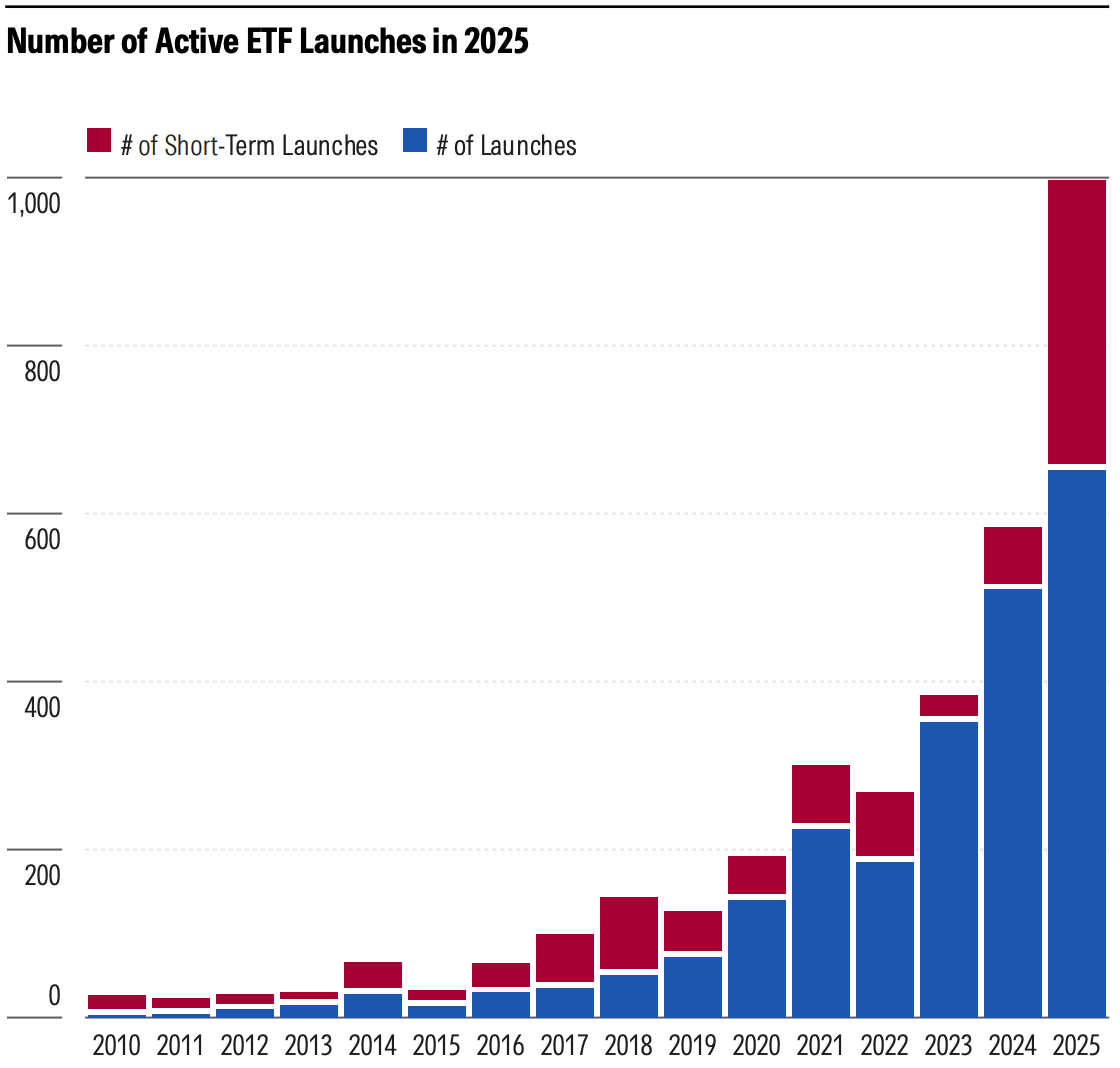
Source: Morningstar. Data as of Dec. 31, 2025.
Top Active ETFs Ranked by Flows
Twenty-five funds gobbled up roughly one-third of active ETF inflows. Six of J.P. Morgan’s ETFs made it in the top 25, including its two popular equity-income ETFs, JPMorgan Nasdaq Equity Premium Income ETF JEPQ and JPMorgan Equity Premium Income ETF JEPI.
BlackRock’s iShares U.S. Equity Factor Rotation Active ETF DYNF, which was 2024’s most popular active ETF, took top place again in 2025 with more than $13 billion in inflows, in part because the ETF is included in several of the firm’s target-date and model portfolios, which the firm makes available for advisors to implement for their clients.
As artificial intelligence continued to fuel market gains, BlackRock’s iShares A.I. Innovation and Tech Active ETF BAI, led by veteran manager Tony Kim, took in more than $7 billion.
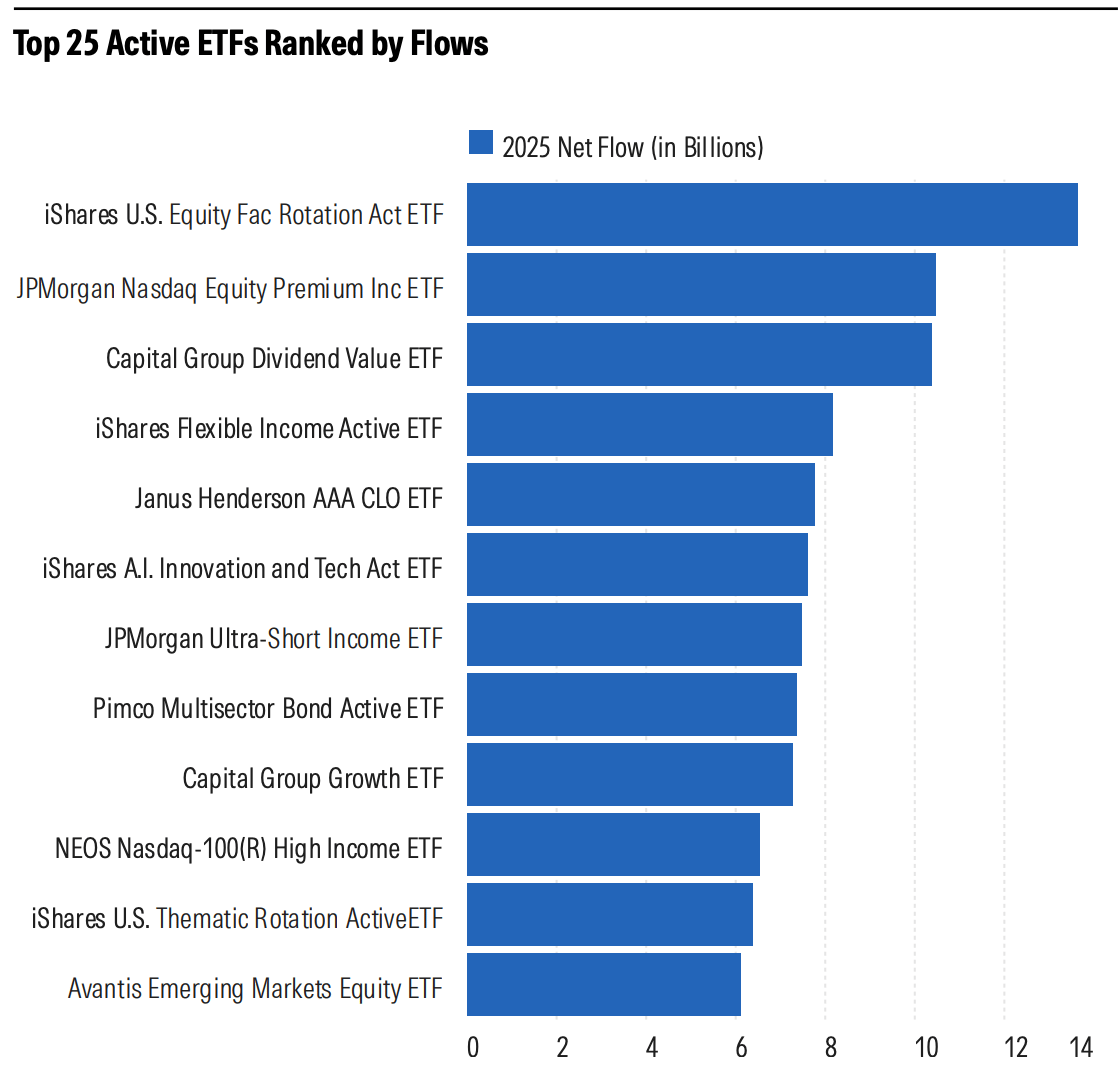
Source: Morningstar. Data as of Dec. 31, 2025.
A Record Number of Active ETF Mergers and Liquidations
As active ETFs hit records on launches in 2025, they also tallied their most mergers and liquidations. About 150 active ETFs were shuttered. Liquidations hit 114, which topped the charts on an annual basis. Thirty-two active ETFs were merged—the third highest annual total behind 2018 and 2019. Most of the ETFs had small asset bases. Funds cost money to operate, and those that don’t garner enough assets are susceptible to being liquidated or merged away.
Assuming ETFs typically have about $250,000 of annual fixed costs, the breakeven for funds would be about $33 million (active ETFs have an average management fee of 67 basis points and net expense ratio of 75 basis points). Of the roughly 150 funds that closed last year, only six had more than $50 million in assets at the start of 2025. Most of the strategies had less than $25 million.
Sixty-seven closures were equity strategies, with about half of those in nontraditional equity strategies. Most of the closed funds (meaning they cease to exist) had only lasted for about 1.75 years, which shows asset managers give the ETFs a short window in which to turn a profit. In total, 39 fixed-income strategies were closed. Most were from one company, Stone Ridge, that shuttered more than 25 of its retirement income strategies.
It was a mixed bag of active ETF strategies that closed with more than $50 million in assets going into 2025. The largest closure was the iShares Frontier and Select EM ETF, which had more than $150 million at the start of 2025. Emerging markets had been a tough area with paltry returns leading up to 2025, so BlackRock’s liquidation of a focused, emerging-market product early in the year wasn’t too surprising. Unfortunately for investors, emerging markets rebounded in 2025.
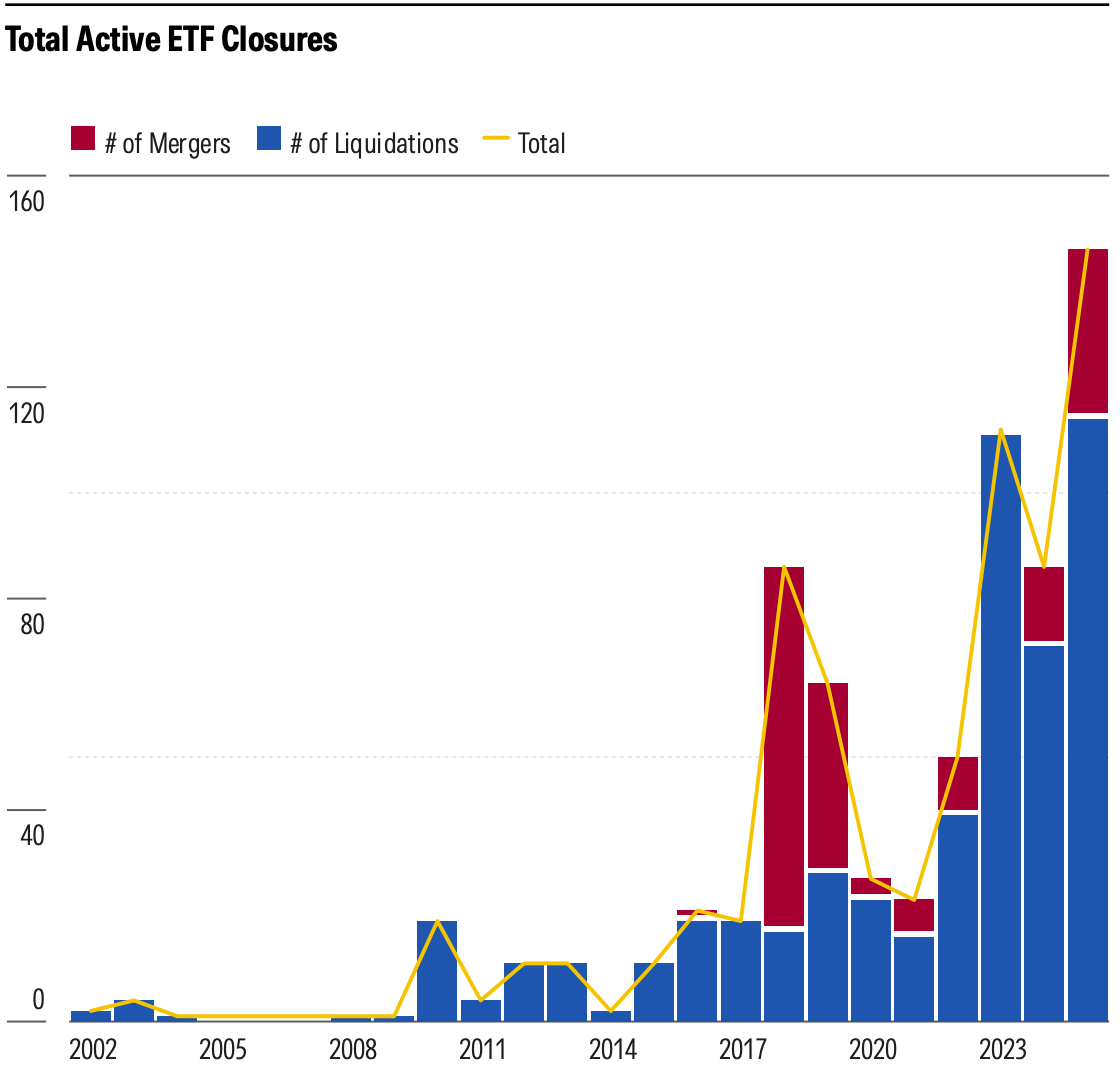
Source: Morningstar. Data as of Dec. 31, 2025.
Closures Should Continue as Many Active ETFs Struggle to Gain Assets
About half of roughly 2,800 active ETFs had more than $50 million in assets as of the end of 2025, leaving 1,260 strategies with less than $50 million. Assuming asset managers give strategies about a year and a half before considering closing, the trend in closures should continue to accelerate, as 462 of those 1,260 strategies have been in existence for more than a year and a half.